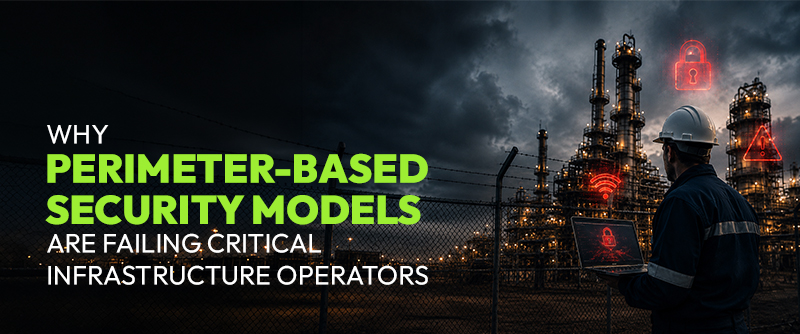
Perimeter-based security models are failing critical infrastructure operators because the network edge they were built to defend no longer exists. Power grids, water utilities, and industrial networks now rely on remote vendor access, cloud dashboards, and internet-connected field devices, all of which sit outside the boundary a traditional firewall can inspect. This shift changed critical infrastructure protection from a question of keeping attackers out to a question of verifying who is already inside. Recent attacks on U.S. water systems confirm the gap is not theoretical. It is active, documented, and expanding.
Perimeter security developed when operational technology networks were physically isolated. Control systems for power plants, water treatment facilities, and pipelines sat on closed networks, often disconnected from the internet entirely. A firewall and a locked control room were sufficient because reaching the network required physical or highly restricted access. Anyone already inside was treated as trusted by default, with no further verification required.
That assumption no longer holds. Digital transformation pushed operators toward remote monitoring, third-party maintenance access, and cloud-connected dashboards for efficiency and uptime. Each new connection quietly expanded the attack surface while the underlying security model stayed unchanged: trust everything inside, inspect only what crosses the edge. Operators kept reinforcing a wall around a network that had already grown far beyond its original design.
Modern attackers rarely break through a perimeter; they walk in through the front door using valid credentials. Phishing, leaked passwords, and compromised remote access tools give adversaries legitimate-looking entry, which perimeter defenses are not designed to question once someone is inside. This shift defines much of the debate around zero trust vs traditional security. Traditional models assume danger comes from outside, while today’s biggest risks often start with a trusted connection that has already been abused.
Third-party vendors add further exposure. A single compromised contractor account can provide a direct path into supervisory control systems without touching the outer network boundary at all. Attackers also scan for internet-facing operational technology devices directly, gaining access without needing to defeat any firewall. Once inside, lateral movement between IT and OT systems happens quietly, often undetected until operational impact appears.
For most industries, a breach means stolen data, financial loss, and reputational damage. For critical infrastructure operators, consequences extend into the physical world. A compromised control system can shut down water treatment, disrupt power distribution, or halt transportation networks that entire communities depend on. This is why critical infrastructure protection cannot be measured by data confidentiality alone; system availability and public safety carry equal, if not greater, weight.
Legacy equipment compounds the problem. Many industrial control systems were never designed with cybersecurity in mind and cannot be patched or replaced without significant downtime and cost. Operators must defend infrastructure that blends decades-old hardware with modern connectivity, often with smaller security teams and tighter budgets than typical enterprise IT departments face day to day.
Recent events confirm these are not theoretical risks. Since late July 2026, water and wastewater utilities across at least seven U.S. states reported cyber incidents to the FBI after attackers remotely accessed internet-facing Rockwell Automation programmable logic controllers, changing IP addresses and passwords to lock operators out of monitoring and control functions. In Minnesota alone, more than thirty municipal water systems were affected, with one treatment plant forced offline. Agencies later linked related activity to an Iran-affiliated campaign targeting operational technology since March 2026.
Separately, researchers disclosed a large-scale credential harvesting campaign affecting tens of thousands of exposed network devices worldwide. Both cases share one pattern: attackers did not breach a hardened perimeter. They used exposed access points and trusted credentials, the exact gap perimeter-only defenses were never built to close.
Regulators and security agencies are now pushing operational technology environments toward zero trust architecture, an approach that removes implicit trust altogether. Every user, device, and application must continuously verify identity and permissions before accessing a system, regardless of network location.
For critical infrastructure operators, this shift typically includes:
This is the practical core of the zero trust versus traditional security debate: continuous verification replaces one-time trust decisions, and access depends on identity and context rather than network location.
The incidents shaping 2026 make one point clear: perimeter defenses alone can no longer protect the systems societies depend on. Operators across Africa’s power, water, and industrial sectors face the same identity-driven threats seen globally, often with fewer resources and smaller teams to respond. CyFrica 2026 summit on 8 October at Eko Convention Center, Lagos brings together security leaders, operators, and policymakers to examine these failures honestly and build practical, achievable paths toward stronger cyber resilience across the continent’s critical systems. Rethinking infrastructure security is not optional. It is the work that determines whether the next incident stays contained or escalates into lasting operational damage.
What does perimeter-based security mean in critical infrastructure?
Perimeter-based security defends a network’s outer boundary while trusting all users and devices inside that boundary automatically, without further verification.
Why does Zero Trust approach matter for operational technology?
Zero Trust architecture removes implicit trust, requiring continuous identity verification for every user and device before accessing operational technology systems.
Are recent water sector attacks linked to perimeter weaknesses?
Yes, attackers accessed internet-facing controllers directly, bypassing perimeter defenses through exposed access points, stolen credentials, and unauthorized device configuration changes.
Can legacy operational technology systems support zero trust principles?
Yes, through network segmentation, restricted remote access, and identity-based controls layered around legacy equipment, without requiring full replacement of infrastructure.
How can operators start improving cyber resilience today?
Begin by removing exposed controllers from the internet, enforcing least-privilege access for vendors, and continuously monitoring identity behavior across systems.