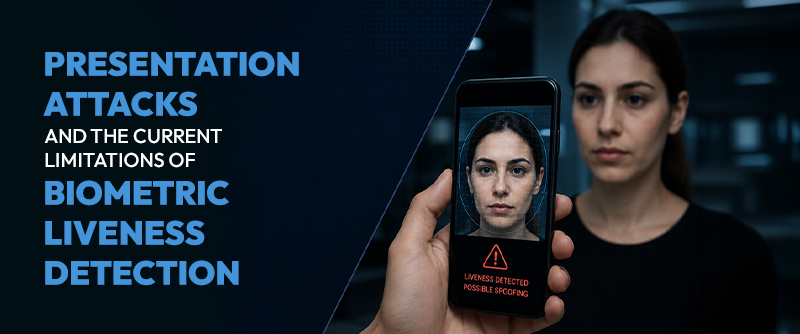
A presentation attack happens when someone shows a fake biometric trait, a photo, mask, or recorded video, to a system instead of their own face. This tactic sits at the center of growing cyberthreats in digital identity ecosystems, where verification checks decide who gets access to banking, government services, and enterprise platforms. As more critical transactions move online, pressure on these checks to work correctly every time has increased, and the cost of a single failure has grown with it. Liveness detection was designed to catch these fakes, yet attackers keep finding new materials and methods to slip past it. This article explains how presentation attacks work, how liveness detection responds today, and where real gaps remain for security teams to address.
A presentation attack is any attempt to fool a biometric sensor using an artificial or recorded trait instead of a live person. The International Organization for Standardization defines this under ISO/IEC 30107, which classifies attacks by artifact type and rates systems on resistance to each category. Independent labs, including iBeta, test biometric vendors against this standard using thousands of simulated spoof attempts alongside genuine user presentations. This testing gives buyers a measurable benchmark instead of relying on a vendor’s own marketing claims, and it forms the baseline most enterprise identity teams now require before approving any new deployment or vendor contract.
Four attack types account for most real-world spoofing attempts against biometric verification systems today, and each targets a different weakness in camera-based capture.
ISO/IEC 30107-3 testing measures how often genuine users are wrongly rejected and how often fake presentations are wrongly accepted, giving each attack type a clear, standardized pass-or-fail threshold that vendors must meet.
Liveness detection splits into two working methods. Passive liveness analyzes a single image or short clip for texture, depth, and reflection cues without asking the user to act, making it fast and unobtrusive. Active liveness asks users to blink, turn their head, or follow an on-screen prompt, adding a response step that static images cannot fake. Many vendors combine both approaches with AI-powered threat detection models trained on genuine and spoofed samples to catch subtle inconsistencies that human reviewers routinely miss. Top providers have passed independent, NVLAP-accredited testing with zero errors across thousands of attempted spoofs. However, attacker resourcing continues to rise steadily to match these improving defenses across the industry.
Standard testing assumes attackers with limited budgets and basic tools, but funded fraud operations now use professional-grade materials and generative AI that older certifications never anticipated when they were first written. This is where cyberthreats in digital identity ecosystems consistently outpace lab-based benchmarks and slower certification cycles. Increasingly realistic synthetic textures can fool passive liveness, while active liveness prompts add friction that pushes some organizations to weaken checks for user conversion and onboarding speed.
iBeta’s Level 3 testing, built around advanced materials and AI-generated faces, confirms this gap exists in practice. Only a small number of vendors have passed it so far, and error thresholds tighten every six months as attack sophistication grows across the identity verification industry.
Deepfake selfie attempts rose 58% in a single year, and injection attacks, which feed manipulated video directly into a verification pipeline, surged 40% year-over-year, according to recent industry fraud data. Injection attacks are especially difficult to stop because they bypass the physical camera entirely, using virtual camera software to stream synthetic faces straight into the authentication process without ever facing a real lens. Data on AI cybersecurity in Africa shows Southern African verification networks now link nearly nine in ten rejected biometric attempts to impersonation or spoofing, showing how fast this threat has spread across emerging identity markets and onboarding channels.
No single check stops every spoofing method, so layered defense has become the industry standard across identity verification. Combining passive and active liveness, device signals, document checks, and injection detection creates overlapping barriers that are far harder to defeat than any one method used alone. AI & Cybersecurity frameworks built around continuous monitoring, rather than one-time onboarding checks, catch attacks that evolve after enrollment, strengthening resilience across varied regulatory environments, user bases, and transaction types.
Forums focused on AI cybersecurity in Africa are becoming necessary as presentation attacks grow more advanced across the continent’s fast-expanding digital economies. CyFrica Summit brings together identity verification vendors, financial institutions, and policy leaders to share practical defenses against evolving biometric fraud. Sessions on AI and cybersecurity give attendees direct access to testing standards, deployment case studies, and current threat data shaping how liveness detection is built, audited, and improved across African markets and regulatory bodies working toward shared resilience.
A presentation attack shows a fake biometric trait, such as a photo, mask, or video, to fool a liveness check.
Can liveness detection be fooled?
Yes, sophisticated masks, deepfakes, and injection attacks can bypass older or single-layer liveness systems, especially without continuous, layered verification today.
What is a digital injection attack?
A digital injection attack feeds manipulated video directly into a verification system’s pipeline, bypassing the physical camera and capture process.
What is ISO 30107-3 testing?
ISO 30107-3 is an independent standard measuring how well biometric systems resist standardized, real-world presentation attack types under lab conditions.
Why does layered defense matter?
Layered defense combines multiple checks, so attacks that slip past one detection method get caught by another, independent verification layer.